
Cognitive Behavioral Therapy
Cognitive Behavioral Therapy (CBT)
is a form of therapy that emphasizes the important role of thinking in how we feel and what we do.
CBT does not exist as a distinct therapeutic technique. CBT is a very general term for a classification of therapies with similarities (i.e., Cognitive Therapy, Dialectic Behavior Therapy, Self-Instructional Training, and Rational Emotive Behavior Therapy)
“We can’t solve problems by using the same kind of thinking we used when we created them.”
Albert Einstein
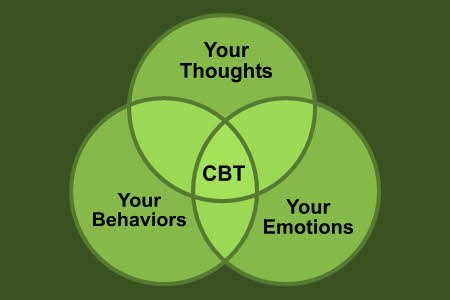
Most cognitive-behavioral therapies have the following characteristics:
CBT is based on the cognitive model of emotional response. CBT is based on the idea that our thoughts cause our feelings and behaviors, not external things, like people, situations, and events. The benefit of this fact is that we can change the way we think to feel/act better even if the situation does not change.
CBT is briefer and time-limited. CBT is considered among the most rapid in terms of results obtained. The average number of sessions clients receive (across all types of problems and approaches to CBT) is only 16. Other forms of therapy, like psychoanalysis, can take years. What enables CBT to be briefer is its highly instructive nature and the fact that it makes use of homework assignments. CBT is time-limited in that we help clients understand at the beginning of the therapy process that there will be a point when the formal therapy will end. The ending of the formal therapy is a decision made by the psychologist and client. Therefore, CBT is not an open-ended, never-ending process.
A sound therapeutic relationship is necessary for effective therapy, but not the focus. Some forms of therapy assume that the main reason people get better in therapy is because of the positive relationship between the psychologist and client. Cognitive-behavioral psychologists believe that a good trusting relationship is important, but not enough. CBT psychologists believe that clients change because they learn how to think differently and then act on that learning. Therefore, CBT psychologists focus on teaching rational self-counseling skills.
CBT is a collaborative effort between psychologist and client. Cognitive-behavioral psychologists seek to learn what their clients want out of life (their goals) and then help them achieve those goals. The psychologist’s role is to listen, teach, and encourage, while the client’s role is to express concerns, learn, and implement that learning.
Some approaches to CBT are based on aspects of stoic philosophy. Stoicism is an ancient Greek philosophy that teaches living in accordance with reason, focusing on what is within our control, and cultivating virtue to achieve a flourishing life. CBT does not tell people how they should feel. However, most people seeking therapy do not want to feel the way they have been feeling. The approaches that emphasize stoicism teach the benefits of feeling, at worst, calm when confronted with undesirable situations. They also emphasize the fact that we have undesirable situations whether we are upset about them or not. Thus, if we are upset about our problems, we have two problems – the problem and our feelings about the problem. Most people want to have the fewest number of problems possible. So, when we learn how to more calmly accept a personal problem – how to control our reactions or feelings about it – not only do we feel better, but we usually put ourselves in a better position to make use of our intelligence, knowledge, energy, and resources to resolve the problem.
CBT uses the Socratic method. Cognitive-behavioral psychologists want to gain a very good understanding of their clients’ concerns. That’s why they often ask questions. They also encourage their clients to ask questions of themselves, like, “How do I really know what people are thinking about me?” “Could they be thinking about something else?” “Something that maybe has nothing to do with me?”
CBT is structured and directive. CBT psychologists have a specific agenda for each session. Specific techniques and concepts are taught during each session. CBT focuses on the client’s goals. We do not tell our clients what their goals “should” be, or what they “should” tolerate. We are directive in the sense that we show our clients how to think and behave in ways to obtain what they want. Therefore, CBT psychologists do not tell their clients what to do — rather, they teach their clients how to do.
CBT is based on an educational model. CBT is based on the scientifically supported assumption that most emotional and behavioral reactions are learned. Therefore, the goal of therapy is to help clients unlearn their unwanted reactions and to learn a new way of reacting. Therefore, CBT has nothing to do with “just talking”. People can “just talk” with anyone. The educational emphasis of CBT has an additional benefit — it leads to long-term results. When people understand how and why they are doing well, they know what to do to continue doing well.
CBT theory and techniques rely on the inductive method. A central aspect of rational thinking is that it is based on fact. Often, we upset ourselves about things when, in fact, the situation isn’t like we think it is. If we knew that, we would not waste our time upsetting ourselves. Therefore, the inductive method encourages us to look at our thoughts as being hypotheses or guesses that can be questioned and tested. If we find that our hypotheses are incorrect (because we have new information), then we can change our thinking to be in line with how the situation really is.
Homework is a central feature of CBT. If when you attempted to learn your multiplication tables you spent only one hour per week studying them, you might still be wondering what 5 X 5 equals. You very likely spent a great deal of time at home studying your multiplication tables, maybe with flashcards. Similarly, if you want to learn how to play a musical instrument well enough to perform in a band, you will need to ply that instrument more than during your weekly lesson. Daily practice produces the learning and ability and skill you seek. The same is the case with psychotherapy. Goal achievement (if obtained) could take a very long time if a person only thought about the techniques and topics for one hour per week. That’s why CBT psychologists assign readings and encourage their clients to practice the techniques learned.
The above information has been provided with the kind permission of the National Association of Cognitive Behavioral Therapies (read more at https://www.nacbt.org/whatiscbt-htm/).
National Association of Cognitive Behavioral Therapies
I strongly encourage you to go to this source document, as they provide additional information (that I have not recreated here) about important aspects of CBT, such as how it helps you become your own therapist, the emphasis in terms of your current life, how it aims to change behavior patterns, and more.